Detroit is a city in the midst of a remarkable transformation. After decades of population decline and economic contraction, the city has seen significant reinvestment in its neighborhoods, with vacant and underutilized properties being reclaimed for new residential, commercial, and community uses. Central to this transformation is the process of Lot Clearing Detroit the preparation of individual parcels of land that have fallen into disuse, overgrowth, or neglect.
Lot clearing is both a practical service and a catalyst for neighborhood revitalization, converting eyesores into opportunities. Understanding what the process involves helps property owners, developers, and community organizations appreciate the scope of work and the value it creates.
What Is Lot Clearing?
Lot clearing refers to the process of removing all vegetation, debris, and obstructions from a defined parcel of land to prepare it for a new purpose. This can include clearing trees, shrubs, brush, weeds, old building materials, discarded debris, and any existing surface features that are no longer needed.
Lot clearing is typically one of the first physical steps in a property improvement or development project. It applies to vacant urban lots, formerly developed parcels where structures have been demolished, rural or suburban properties with overgrown vegetation, and any parcel where the land’s condition prevents it from being used productively.
Common Scenarios for Lot Clearing in Detroit
Detroit presents a particularly diverse range of lot clearing scenarios, reflecting the city’s complex history and ongoing revitalization efforts.
Vacant residential lots are among the most common applications. Throughout Detroit’s neighborhoods, decades of population loss left thousands of lots where homes once stood. These parcels, now owned by the Detroit Land Bank Authority or private investors, are often heavily overgrown with invasive species, volunteer trees, and accumulated debris. Clearing these lots is the first step toward making them ready for new construction, community gardens, greenways, or other productive uses.
Formerly developed commercial and industrial sites present more complex clearing challenges. These properties may contain buried foundations, remnant utility infrastructure, soil contamination from past industrial activities, and large concrete slabs that must be broken up and removed. Professional lot clearing contractors with experience in urban infill sites understand how to manage these challenges safely and efficiently.
New residential and commercial development projects on previously undeveloped or minimally developed parcels also require lot clearing as the foundation of site preparation. Even lots with limited vegetation must be fully assessed and cleared of any subsurface material that could interfere with new construction.
The Lot Clearing Process
Professional lot clearing follows a defined sequence of steps designed to ensure that work is done safely, efficiently, and in compliance with local regulations.
The process begins with an assessment of the parcel. A qualified contractor walks the property to inventory what needs to be removed noting tree species and sizes, the presence of structures or debris, potential underground hazards, and any environmental features such as wetlands or drainage features that require special attention. Utility locating through MISS DIG is always completed before ground-disturbing work begins.
Permitting comes next. In Detroit, tree removal above certain sizes typically requires permits, and demolition or removal of structures requires inspection and approval from the city’s building department. An experienced lot clearing contractor guides clients through the permitting process and ensures all required approvals are in place before work starts.
The physical clearing work typically begins with the removal of brush, small trees, and surface debris. This is followed by the felling and removal of larger trees, grinding of stumps to below grade level, and removal of any structures, slabs, or buried debris. The cleared material is managed according to its type organic material may be chipped and recycled, concrete and masonry crushed and repurposed, and regulated materials disposed of through licensed handlers.
After all material has been removed, the lot is typically graded to smooth out the surface, fill any depressions, and establish basic drainage patterns. The cleared and graded lot is then ready for whatever comes next construction, landscaping, or another beneficial use.
Equipment Used in Lot Clearing
The equipment brought to a lot clearing project depends on the size and nature of the parcel and the material being removed.
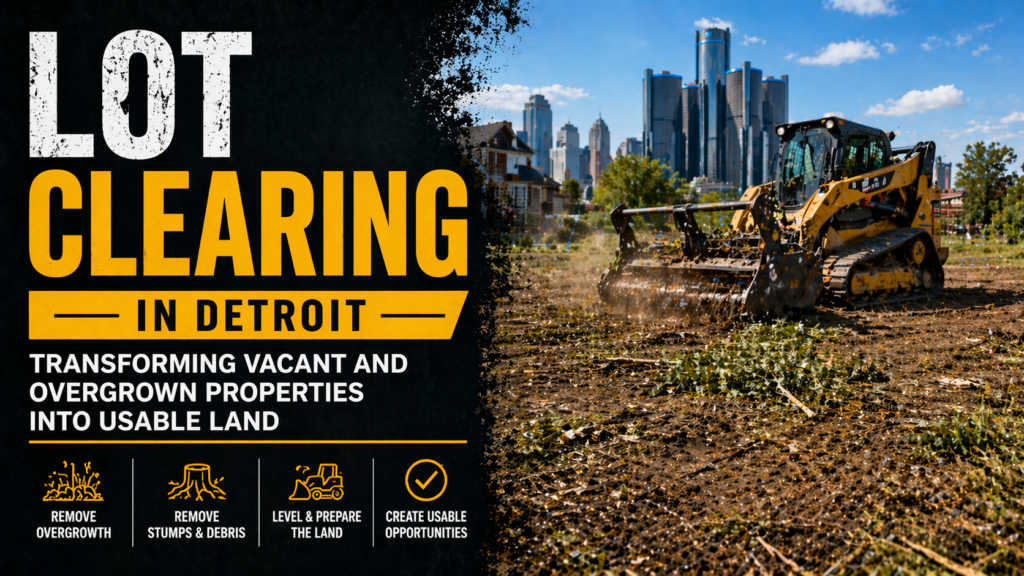
Compact equipment such as skid steer loaders and compact track loaders with brush cutter or forestry mulcher attachments are well suited to residential-scale lot clearing in Detroit, where lots are typically 40 to 60 feet wide and often bordered by structures that limit access. These machines are maneuverable, powerful, and capable of clearing dense vegetation efficiently.
For larger parcels, full-size bulldozers, excavators, and wood chippers may be added to the equipment mix. Stump grinders either mounted on equipment or as standalone units are used to remove tree stumps below grade so that they do not interfere with grading or future construction.
For lots with existing concrete slabs or building foundations, hydraulic breakers, concrete saws, and front-end loaders are used to break up and remove the material. Dump trucks transport cleared debris and demolition material off-site.
Lot Clearing and Property Value
One of the most tangible benefits of lot clearing is its impact on property value. An overgrown, debris-strewn lot is difficult to market and may create liability for the property owner if the condition poses hazards to neighbors or passersby. A cleared lot, by contrast, is far more marketable and allows potential buyers or developers to visualize the possibilities the property offers.
For community development organizations and the Detroit Land Bank Authority, lot clearing is a key tool in reducing blight and improving the overall condition of neighborhoods. Research has consistently shown that the removal of blighted and overgrown properties correlates with reductions in crime rates, improvements in property values for surrounding homes, and increased community investment.
Environmental Responsibility in Lot Clearing
Professional lot clearing in Detroit is conducted with attention to environmental stewardship. Material salvage and recycling are standard practices wood from cleared trees is often chipped for use as mulch, firewood, or biomass fuel; concrete and masonry is crushed and recycled as fill aggregate; and metals are sent to recycling facilities.
Erosion control is also an important consideration, particularly during and immediately after clearing when the ground surface is exposed. Silt barriers, erosion control blankets, and prompt seeding of cleared areas help prevent soil loss and protect nearby drainage systems from sediment loading.
Final Thoughts
Lot clearing in Detroit is a service with significance that extends well beyond any individual property. It is part of the larger story of a city working to reclaim its land and reimagine its future. For property owners, developers, and community organizations, understanding the lot clearing process from assessment to final grading is essential for planning successful projects and making the most of Detroit’s vast stock of available land.